
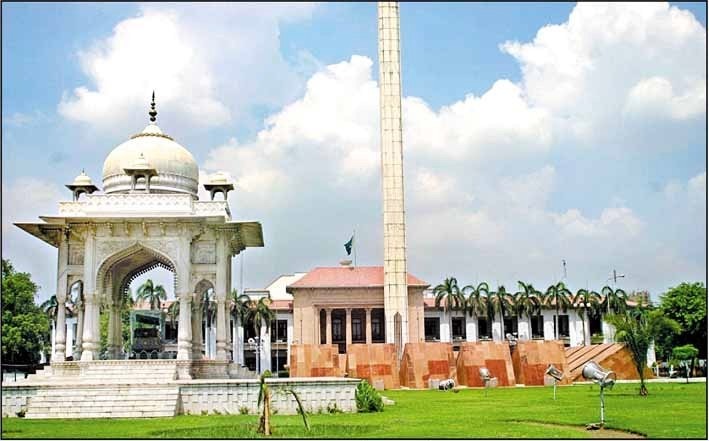
Punjab Assembly building in Lahore, Pakistan. (Sunni Person, Creative Commons)
LAHORE, Pakistan (Christian Daily International–Morning Star News) – A Christian lawmaker on Tuesday (March 31) introduced a bill in the Punjab Assembly seeking to criminalize forced religious conversions with penalties of up to five years in prison.
Falbous Christopher, chairman of the assembly’s Standing Committee on Minority Affairs, submitted the Punjab Protection of the Rights of Religious Minorities Bill 2026 in a renewed attempt to address a long-standing human rights challenge affecting Pakistan’s religious minorities, particularly Christian and Hindu women and underage girls.
The bill aims to establish a comprehensive legal framework to curb forced conversions, forced marriages and systemic discrimination against minority communities. It comes amid heightened scrutiny following cases such as that of Maria Shahbaz, a 13-year-old Christian girl whose abduction and forced conversion/marriage sparked nationwide protests and renewed calls for stronger legal safeguards for vulnerable minority girls.
Under the proposed legislation, anyone who “compels or attempts to compel” a person belonging to a religious minority to convert through threats, coercion or undue influence would face up to five years’ imprisonment and a fine. The bill clearly distinguishes between forced and voluntary conversions, excluding the latter from punishment.
Christopher said the formal recognition of forced conversion as a specific crime could help address longstanding gaps in Pakistan’s legal framework, where such cases are often pursued under broader provisions that do not explicitly address religious coercion.
“While legislation is essential, its real impact will depend on effective implementation, coordination among institutions and protection mechanisms for vulnerable individuals, especially women and girls,” Christopher told Christian Daily International-Morning Star News.
Beyond criminal penalties, the bill grants courts expanded authority to intervene in cases involving forced marriages of religious minorities in the 96-percent Muslim country. Judges would be empowered to issue protection orders and conduct independent inquiries, ensuring that victims are not pressured into remaining in abusive or unlawful relationships.
The proposed law stipulates that marriages involving minorities can only be declared void through court orders, aligning such decisions with existing marriage, child protection and guardianship laws. It also classifies offenses motivated by religious hatred as aggravated crimes, requiring courts to consider such motives during sentencing.
Christopher said these provisions are intended to address recurring patterns seen in previous cases, where girls have struggled to access timely legal remedies or adequate protection from kidnappers.
Systemic Discrimination
The legislation extends beyond forced conversions to tackle broader structural discrimination faced by minority communities in Punjab, Pakistan’s most populous province and home to a significant Christian population.
It proposes a prohibition on religious bias in employment, education, access to public services and entry to public spaces, while mandating state protection of minority places of worship and religious property.
“No person shall damage, desecrate or unlawfully occupy any place of worship or religious property belonging to a religious minority,” the bill states.
In addition, the proposed law calls for a review of educational curricula to remove material that promotes hatred, intolerance or discrimination, an issue frequently highlighted by rights groups as a key driver of societal prejudice.
Christopher emphasized that legal reform must be accompanied by broader societal change.
“We must also address the root causes of intolerance through education reform and community engagement to build a more inclusive and peaceful society,” he said.
Introduction of the bill follows a series of controversial cases involving the alleged forced conversion of minority girls, particularly from Christian and Hindu communities. The case of Maria Shahbaz drew widespread attention after rights groups alleged that the Christian teenager had been abducted, forcibly converted to Islam and married to a Muslim man twice her age.
Courts, including the Federal Constitutional Court, upheld the marriage, prompting outrage among the Christian community and activists who argued that questions of coercion and age determination were not adequately examined.
Such cases have become emblematic of broader concerns about the vulnerability of minority women and girls, who advocacy groups say are often targeted due to socio-economic marginalization and weak legal protections.
History of Opposition
Efforts to enact laws against forced conversions in Pakistan have historically faced strong political and religious opposition.
In 2021, a federal bill aimed at preventing forced conversions was effectively shelved following resistance from Islamist parties during the government of former prime minister Imran Khan. Critics argued that the proposed legislation could be misused or infringe upon religious freedoms, while supporters maintained it was necessary to protect vulnerable minorities.
The Council of Islamic Ideology, which advises the government on religious matters, and various religious groups raised objections to provisions such as minimum age requirements for conversion and mandatory judicial oversight, contributing to the bill’s withdrawal before it could be passed.
The Punjab bill will now be referred to the Standing Committee on Minority Affairs for review and deliberation. If approved, it will be tabled in the provincial assembly for debate and a vote.
If enacted, the legislation would represent one of the most comprehensive provincial frameworks aimed at protecting religious minorities in Pakistan addressing not only forced conversions but also discrimination, hate-motivated offenses and the protection of religious sites.
Rights advocates, however, caution that legislation alone will not be sufficient to bring meaningful change.
“The real test will be implementation,” said prominent Christian attorney Lazar Allah Rakha, noting that police inaction, social pressures and prolonged legal proceedings have historically undermined protections for minority victims.
International advocacy groups continue to highlight the challenges faced by religious minorities in Pakistan. In its 2026 World Watch List, Open Doors ranked Pakistan eighth among the 50 countries where it is most difficult to practice Christianity, underscoring the urgency of legal and institutional reforms.
If you would like to help persecuted Christians, visit https://morningstarnews.org/resources/aid-agencies/ for a list of organizations that can orient you on how to get involved.
If you or your organization would like to help enable Morning Star News to continue raising awareness of persecuted Christians worldwide with original-content reporting, please consider collaborating at https://morningstarnews.org/donate/?
###
© 2026 Christian Daily International-Morning Star News. Articles/photos may be reprinted with credit to Christian Daily International-Morning Star News. https://morningstarnews.org
Tweet: https://twitter.com/morningstarnewz/
Facebook: https://www.facebook.com/MorningStarNews
Morning Star News is a 501(c)(3) non-profit corporation that relies solely on contributions to offer original news reports of persecuted Christians. By providing reliable news on the suffering church, Morning Star News’ mission is to empower those in the free world to help and to encourage persecuted Christians that they are not forgotten or alone. For free subscription, contact editor@morningstarnews.org; to make tax-deductible donations, visit https://morningstarnews.org/donate/? or send check to Morning Star News, 34281 Doheny Park Rd., # 7022, Capistrano Beach, CA 92624, USA.

The post Bill Would Criminalize Forced Conversion in Punjab, Pakistan appeared first on Morningstar News.
Become a Christian News Network Supporter...

 Dear Reader, has ChristianNews.net been of benefit and a blessing to you? For many years now, the Lord has seen fit to use this small news outlet as a strong influential resource in keeping Christians informed on current events from a Biblical worldview. With much compromise and many falsehoods in modern-day Christianity, we strive to bring you the news by keeping Christ and His word in focus. If you have benefited from our news coverage, please prayerfully consider becoming a Christian News supporter by clicking here to make a one-time or monthly donation to help keep the truth of God's word widely and freely published and distributed.
