
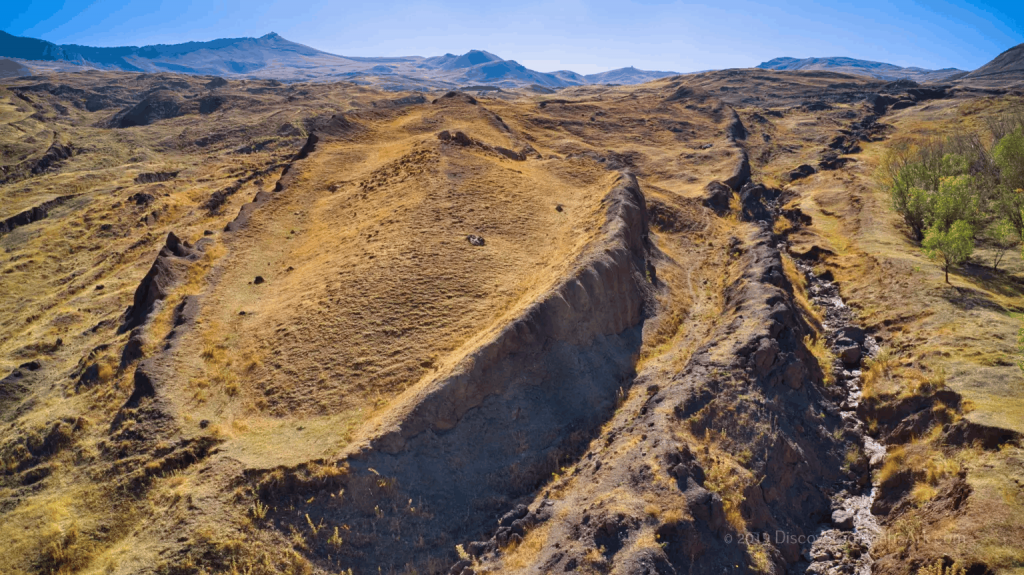
 (Christian News) — A team of international researchers claims to have unearthed fragments of charred and uncharred wood 30 feet beneath the surface of Eastern Turkey’s Formation. The controversial site—a 538-foot-long, ship-shaped geological structure situated near Mount Ararat—has captivated biblical scholars, archaeologists, and Ark hunters since its discovery in 1959.
The investigation, led by the research group Noah’s Ark Scans in partnership with Turkey’s Sivas Cumhuriyet University, recovered the subsurface material during deep core drilling operations. Before drilling, the team conducted ground-penetrating radar scans using specialized tech designed to filter out surrounding natural geology. According to project leaders, the scans revealed a network of organized internal patterns, corridors, and three distinct horizontal levels beneath the mudflow.
Dr. Khosrow Bakhtar, a defense scientist and radar specialist who analyzed the scans, described the results as a career highlight. “This is the most significant finding of 45 years of my career,” Dr. Bakhtar stated during a presentation at the Noah’s Ark Symposium. “It’s not geologic related, because we masked all the geologic features.”
Dr. Cenker Atila, an archaeology professor who oversees the project at Sivas Cumhuriyet University, noted that the radar signatures closely mirror early biblical descriptions of the vessel. “In our Holy Books, Noah’s Ark had three levels; in our radar studies, we also identified a formation with three levels,” Atila told reporters.
In addition to the retrieved timber fragments, research teams noted that initial testing of the surrounding subterranean soil layers showed elevated concentrations of organic matter and potassium. Specialists on the team explained the correlation, stating, “As wood decays, you’re gonna find elevated organic matter.”
Despite the team’s enthusiasm, other geologists and independent scientists continue to urge caution. The Durupınar site has been scrutinized repeatedly over the past six decades, with critics describing the natural rock mound as a doubly plunging syncline—a common geological formation formed by natural earth movements and mudflows. Previous microscopic examinations from past decades concluded that previous claims of fossilized structural beams were simply weathered volcanic minerals and metamorphosed rock.
Independent observers reviewing the project data warn that chemical shifts in soil profiles do not prove the existence of an ancient ship, pointing out that localized vegetation decay and natural soil chemistry routinely create similar organic signatures.
The newly retrieved wood fragments and dark soil samples have been dispatched to accredited laboratories for carbon-14 radiocarbon dating and petrographic testing. Project leaders emphasize that no firm conclusions should be drawn until the laboratory results are complete and published. Until third-party laboratories establish whether the wood is ancient timber or man-made material, the question of whether the Durupınar Formation harbors the world’s most famous vessel remains open for debate.
Become a Christian News Network Supporter...

 Dear Reader, has ChristianNews.net been of benefit and a blessing to you? For many years now, the Lord has seen fit to use this small news outlet as a strong influential resource in keeping Christians informed on current events from a Biblical worldview. With much compromise and many falsehoods in modern-day Christianity, we strive to bring you the news by keeping Christ and His word in focus. If you have benefited from our news coverage, please prayerfully consider becoming a Christian News supporter by clicking here to make a one-time or monthly donation to help keep the truth of God's word widely and freely published and distributed.

